Posts

Create Task Day 2

Today I added a few more functions, including puzzle, guess_letter, and guess_whole. The guesses allow the user to make guesses, obviously, and then see if the guess matches any of the letters in the message. The puzzle just turns the input message into a list. I haven't hit any major roadblocks yet, but I do anticipate some because it's starting to get complicated. Scale 1-10: 2

Create Task Day 1

Today I began my hangman code. The first problem I ran into was creating an array in python to count the number of characters in an input that someone gives. I looked up how to do it, so that wasn't that hard. The next problem is going to be dealing with the difference between spaces and characters, and then filling in the characters once the user guesses one right. I also created a function called guess, which accepts a letter input from the user as a guess. That's all for today. Scale of 1-10: 1

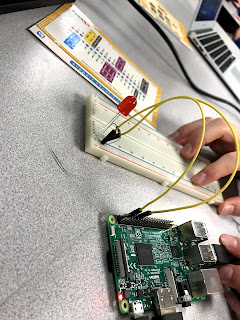
LED

Image
LED 1: Here's our LED thing, it wasn't working at first. The light has a long wire and a short wire, and it matters which one goes where. When I reversed the wires it worked. LED 2: Here's the new setup for LED 2 and 3. It didn't work at first, so Abby helped us fix our configuration. After the configuration was fixed and the code was double-checked, both 2 and 3 worked smoothly.

Private and Public keys

Private key encryption: uses symmetric keys, probably the least secure because if someone knows the key they can immediately get access on both sides. Public key encryption: more secure, uses asymmetric keys as well as certificate authorities and https to verify the trustworthiness of a website. This makes the connection more secure, but not completely safe. "It locks the door, but there's still a door." - Ms. Kelly

2a. and 2b.

2a. This program is written in python. Its purpose is to allow the user to create a shopping list. They can add items, remove items, and see the working list. When the user is finished, the list is saved. The video shows the program running in a terminal window. First, the name of the user is input, then the user can choose to see the list, add an item, remove an item, or quit the program. The user adds three items, removes an item, adds an item, looks at the list, then enters 'quit'. 2b. First I created a program that gave the user the information necessary to run the program - 1 shows the list, 2 adds to the list, 'quit' exits the program - and accepted input from the user. Then I added functions that perform the commands of 1 and 2. When the input was entered, the program performed the command. Additionally, a greeter function greeted the user at the beginning of the program, clearing the terminal window beforehand. Next, I added two functions to get the name of th...
IP

What is a protocol? "A well-known set of rules and standards used to communicate between machines."  The internet must follow a protocol so that all machines using it can effectively communicate. What is an Internet Protocol (IP) address? An IP address is a number unique to each device on a network. It works a lot like a mailing address, where a device finds another address and also sends its return address so the two devices can communicate. How is it organized hierarchically? The first numbers identify the country and regional network of the device, then the subnetworks, then the address of the specific device. How many bits are in an IPv4 address? 32 How many IPv4 addresses does that mean there are?   2^32 What is the difference between IPv6 and IPv4.   IPv6 has 128 bits, IPv4 has 32 bits. Why do we need IPv6? IPv4 does not have enough possible addresses for all the devices in the world, so we have to add more bits. What ...

Perfection is Normal

In the world of computers, which is rapidly encompassing the entire world, perfection is becoming the new norm. People expect that when they send a message, it will be delivered exactly as intended. When they send a photo, the photo received will be identical to the one sent. Human error is expected. A typo in an essay is normal. A wrong turn is normal. But even these human errors are being corrected by computers. Autocorrect counters human error in messages and a GPS flawlessly directs a driver to an intended destination. As the trend toward increased computer usage continues, so too will the trend toward perfection, and it will become normal. As a student, the perfection of computers allows a highly efficient and reliable transfer of data between teachers and students. Teachers can print out documents for students to read, knowing that all students are receiving the same information. Students can submit assignments without ever seeing the teacher. I'm currently in a VHS class...